
Channel Letter Signs: Styles, Costs, and How They Work
When a storefront sign stops traffic at night, it's almost always a set of channel letters doing the work. These three-dimensional, individually shaped letters are the most recognized form of commercial storefront signage in the United States, and businesses choose them because they deliver visibili
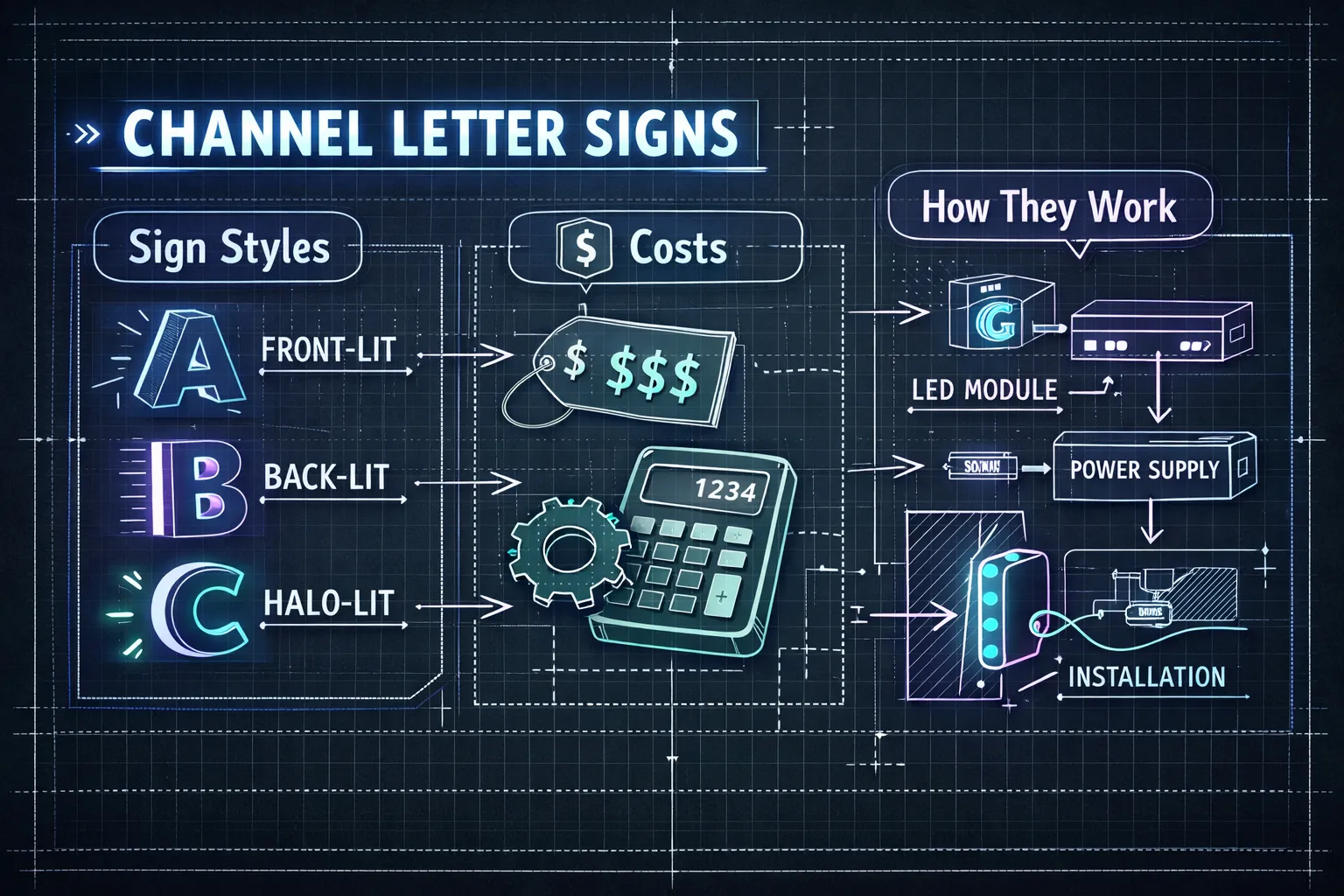 Channel letter signs: styles, costs, and how they work
When a storefront sign stops traffic at night, it's almost always a set of channel letters doing the work. These three-dimensional, individually shaped letters are the most recognized form of commercial storefront signage in the United States, and businesses choose them because they deliver visibility that flat signs simply can't match. They read from a distance during the day, and at night they glow with a confidence that tells customers you're open and worth walking in.
This guide covers everything you need to make a smart decision about channel letter signs: the main styles and what each one actually looks like in real life, realistic cost ranges for 2025 and beyond, how installation works, and what the permitting process involves here in California. At Anaheim Signs, we've been fabricating and installing custom channel letters for Orange County businesses for over 40 years, so the information here comes directly from the shop floor, not a spec sheet.
What channel letter signs are and why storefronts choose them
The anatomy of a channel letter
Each channel letter is essentially a shallow, custom-shaped metal box. The structure consists of aluminum returns (the sides that give the letter its depth, typically 3 to 5 inches for most storefronts), an acrylic or aluminum face on the front, and an aluminum back panel. LED modules sit inside the letter, and a power supply feeds each set. Every component is fabricated to match your brand's exact font, size, and color, which is why no two sets look identical.
The letters are installed either individually on a wall surface (direct mount) or attached to a raceway box that houses the wiring. Each approach has its own look and practical advantages, which we'll cover in the installation section below. For an accessible primer on the basics and common design choices, see A Beginner's Guide to Channel Letter Signs, Anaheim Signs.
Why illuminated channel letters outperform flat signage for visibility
Channel letters have a physical presence that printed vinyl or painted signs don't. The dimensional form creates shadow and depth during daylight, giving your business name a sculptural weight that reads from across a parking lot. At night, internal illumination makes front-lit letters visible well down the block, and halo-lit styles produce a glow that looks intentional and premium rather than simply bright. Compare that to a cabinet sign or a flat-cut acrylic panel, and the visual gap is obvious. Channel letters communicate permanence in a way that cheaper alternatives don't.
Main styles of channel letter signs and when each one works
Front-lit channel letters: the everyday workhorse
Front-lit letters, sometimes called face-lit, use a translucent colored or white acrylic face. LEDs inside the letter push light forward through the face, producing a bold, bright glow with high readability from the road. These are the most common type you'll see on storefronts, and for good reason: they work well for almost any business category, from retail shops and restaurants to medical offices and gyms. They're more affordable to fabricate, straightforward to service, and easy to spot at night from a considerable distance. If your priority is clear brand visibility at a sensible price point, front-lit channel letters are where most businesses land.
Halo-lit channel letters: the upscale floating effect
Halo-lit letters, also called reverse channel letters, flip the lighting direction entirely. The face is opaque aluminum with no light coming through the front. Instead, LEDs point backward and cast a soft glow against the wall behind the letters, creating the effect that the letters are floating off the surface. The result is refined, quiet, and unmistakably premium. This style suits brands where image carries real weight: luxury retailers, law firms, upscale salons, medical spas, and fine-dining restaurants. One practical note: halo-lit letters perform best against lighter-colored walls where the glow reflects cleanly. Dark or textured surfaces absorb too much of the light and reduce the effect.
Combination channel letters: front and back illumination together
Combination letters use both a translucent face and rear-facing LEDs simultaneously, producing a dual glow effect. The front face lights up with strong, readable illumination while a halo radiates behind the letters at the same time. This is the most visually dramatic option available, and it works especially well for businesses competing in dense commercial corridors where you need every available tool to stand out. Entertainment venues, restaurant chains, and fitness brands often favor this style when maximum nighttime attention is the goal. For a broader look at the different channel letter types you might consider, see this overview of different types of channel letter signs.
What custom channel letter signs realistically cost in 2025 and 2026
How sign pricing is structured
Online cost ranges for channel letters tend to be frustratingly vague, so here are actual numbers. Channel letters are priced by vertical inch of letter height rather than by square foot, and standard industry formulas for a 3-inch-deep LED sign run roughly $19 per vertical inch for remote channel mount, $21 for raceway mount, and $22 for reverse halo-lit. A complete storefront installation covering a business name and tagline typically lands between $3,500 and $12,000 for most small and mid-sized businesses. Premium halo-lit sets, larger footprints, or signs with complex logo shapes push toward $15,000 and above. For another market perspective on pricing, this article on how much a channel letter sign costs is a helpful cross-reference.
What drives the price up or keeps it down
Several variables move the final number in one direction or the other. Letter height has the biggest impact because taller letters require more material and more powerful LED components. Total character count matters too: a 12-character business name costs more than a 6-character one. Front-lit letters cost less than halo-lit, which in turn cost less than combination styles. Mounting method makes a meaningful difference as well, since raceway mount requires fewer wall penetrations and less labor than direct mount, which translates to a lower installed cost. Wall material, accessibility for the installation crew, and whether permits are included in the quote all factor in. A full-service quote should always bundle design, fabrication, permits, and installation together so there are no surprises after approval.
How channel letter signs are installed
The three mounting methods explained
Flush mount, also called direct mount, involves drilling individual penetrations for each letter, routing wiring through the wall, and attaching each letter with studs or anchors. The finished look is clean and floating with no visible backing structure. It's the most labor-intensive method, but it produces the sharpest aesthetic result for modern building facades.
Raceway mount attaches all the letters to a painted aluminum channel box that houses the wiring and power supplies. The raceway itself mounts to the wall with far fewer penetrations than direct mount, which makes installation faster and easier to service down the line. It's the practical choice for existing buildings, landlords who restrict wall modifications, and projects where installation efficiency matters.
Backer panel mount attaches letters to a flat decorative panel first, and that panel then goes up as a single unit. This approach is well suited for brick, EIFS stucco, or any surface where drilling multiple individual penetrations isn't practical or permitted.
Electrical hookup and what install day looks like
LED channel letters run on low-voltage DC power through a power supply housed within the raceway or mounted remotely inside the building. The electrician routes wiring either through wall penetrations or through the raceway to a power source inside the building. Most standard storefront installs take one to two days from the time the crew arrives on site. When evaluating any sign contractor, confirm that the components are UL-listed and that the installer holds a licensed electrical sign contractor credential. These aren't formalities: they're the standards that protect your building, your sign, and your permit approvals. For timeline expectations from another fabricator's perspective, see this note on how long it takes to produce and install channel letter signs.
Permits, city codes, and why this step matters in California
What illuminated signs require in California
Illuminated storefront signs in California require three separate permits in most municipalities: a sign permit, a building permit, and an electrical permit. The sign permit enforces local zoning rules covering size, placement, illumination type, and setbacks. The building permit confirms that the structural installation is safe. The electrical permit covers wiring, power supplies, and compliance with California Title 24 energy codes, which limit internally illuminated signs to 12 watts per square foot of illuminated sign area and require automatic shutoff controls. Tenants in commercial centers also need to navigate HOA sign programs and landlord approval, which can add another layer to the timeline. For official guidance on sign lighting and Title 24 compliance, see the California Energy Commission's sign lighting guidance.
Why local permitting knowledge makes a real difference
California has some of the most complex sign permitting requirements in the country, and the rules vary significantly from one city to the next. A fabricator unfamiliar with a specific municipality's sign ordinances can add weeks of delays through incomplete submittals or misread zoning codes. This is exactly where 40-plus years of Orange County experience matters. At Anaheim Signs, we manage permit submittals, engineering drawings, and city approvals as part of every project. Owner Rick Hobbs knows the Anaheim, Irvine, and broader Orange County sign codes well enough that the permit process runs in parallel with fabrication rather than after it, which keeps your overall timeline on track.
How to order the right channel letter sign for your storefront
Decisions to make before requesting a quote
A few pieces of information will dramatically speed up your quoting process. Have your building address ready so the sign company can check zoning restrictions and conduct a proper site survey. Know roughly how tall you want the letters and how wide the sign needs to be to fit your facade. If you have a logo, a vector file in AI or EPS format is ideal. It also helps to know your wall material and color, especially if you're considering halo-lit letters. If you're a tenant, pull your lease and check whether your landlord has a sign criteria package: many commercial centers have specific requirements for letter height, color, and mounting method. For help selecting the best illuminated letter style for a storefront, review Selecting Lighted Sign Letters for Your Storefront, Anaheim Signs.
What a full end-to-end process looks like
Working with a full-service fabricator follows a clear sequence: initial consultation and free estimate, site survey, design proof for your approval, permit submittal and city approval, in-house fabrication, and then installation. At Anaheim Signs, every one of those steps happens under one roof with no outsourcing and no surprise subcontractors. From design approval, a standard storefront set of channel letters typically takes two to six weeks through fabrication, with permitting running concurrently. To start the process, contact owner Rick Hobbs directly for a free estimate. You'll get a clear timeline, a complete quote, and direct answers from the person who will actually oversee your project from first call to final installation. For inspiration on maximizing impact with illuminated letters, see Make a Big Impact With LED Channel Lettering, Anaheim Signs.
The clear picture on channel letter signs
Channel letter signs earn their place as the top choice in storefront signage because they deliver on every front: three-dimensional presence during the day, unmistakable illumination at night, and custom fabrication that matches your specific brand identity. No flat sign competes with them for visibility in a busy commercial corridor.
Matching style to brand follows a clear pattern. Front-lit letters offer high readability and strong value for most businesses. Halo-lit letters signal a premium aesthetic for brands where image is part of the product. Combination letters are for when maximum visual impact is the non-negotiable goal. For most Orange County storefronts, realistic budgets land between $3,500 and $12,000, with the permit process staying very manageable when you work with a contractor who has spent decades navigating local codes.
If you're ready to move forward or just want a realistic number to plan around, reach out to Anaheim Signs for a free consultation. We'll assess your location, talk through the right style for your brand, and give you a complete quote with no surprises. Call or email owner Rick Hobbs directly and get the process started the right way.
Explore Our Sign Services